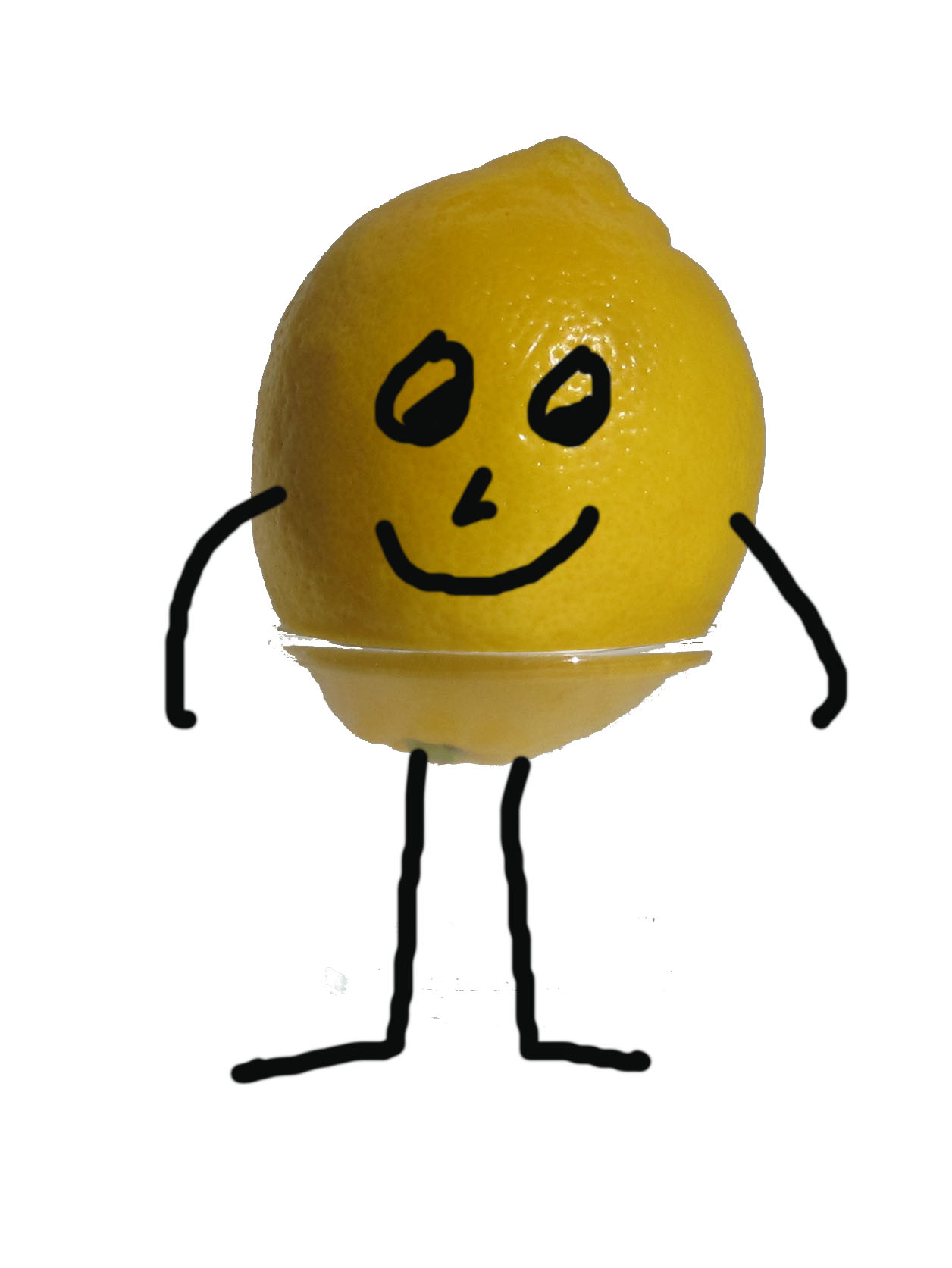
I don’t make it habit to post daily, so two posts in one day is really something of a stretch. Had to share my silliness with photoshop, though…

Reading the World
I don’t make it habit to post daily, so two posts in one day is really something of a stretch. Had to share my silliness with photoshop, though…
After a busy weekend of new Doctor Who, homemade pizza, and kid-friendly cookouts with friends, I tried to get some more pics for my hybrid fruit project. Here’s one of the best pics taken in my dining room using the late afternoon sun.
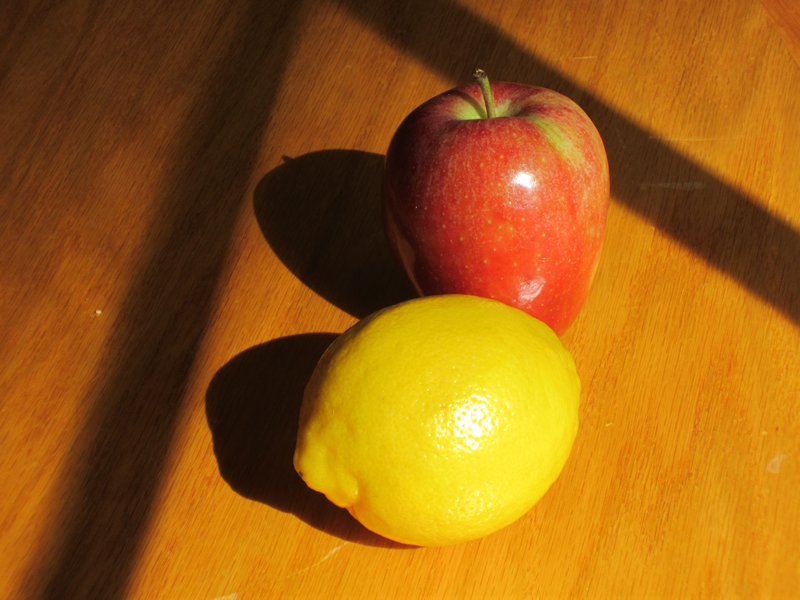
This pic was taken by my husband and without the makeshift white backdrop I created. I took many photographs of this apple and this lemon in a variety of positions and stages of undress, the entire time fighting against the shadows falling from the panes on my dining room window and the toddler who was fascinated by this tripod toy that Mommy wouldn’t let him play with. Eventually, the light gave out, the toddler decided to eat one of the subjects (not the lemon), and Teddy agreed to pose for a few photos.
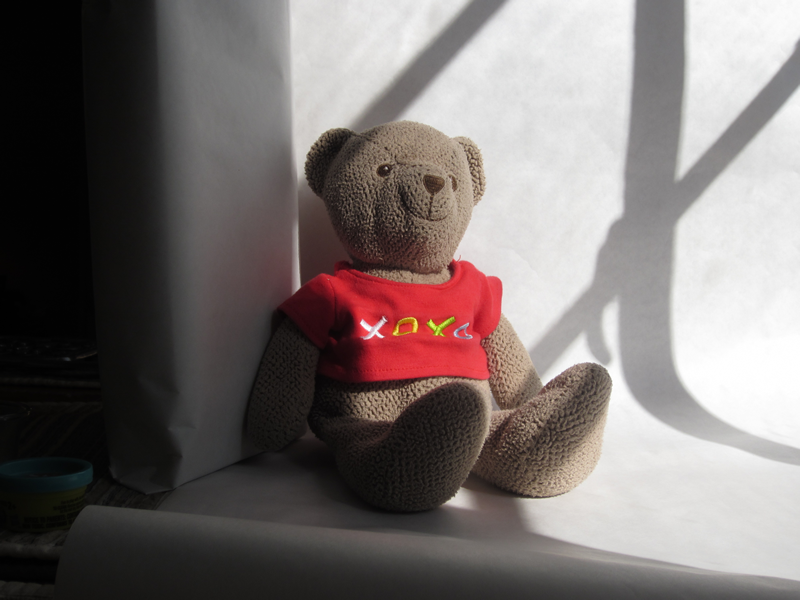
And that’s how I spent my weekend. Tomorrow I get to try to clean up the pics.
We’re all at home this afternoon due to that little squall down in the Gulf of Mexico, so I decided to have a look at the photos I took for the first project in my digital art class. I’ll spare you the horror and just share this picture of my absolutely delectable subjects.
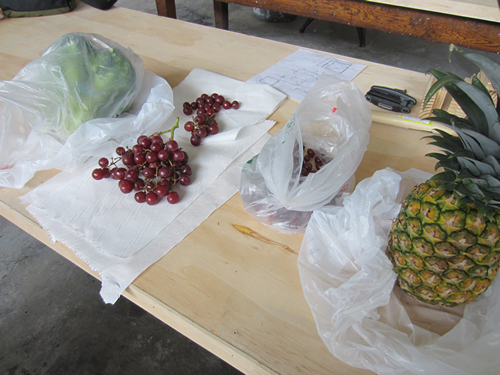 They’re all pretty much gone now; we had the broccoli (in the plastic bag to protect from dust) for lunch with the fabulous Stacy and Mimi, and I have it on good authority that the pineapple provided a perfect morning snack for two hungry toddlers on a rainy day playdate. The grapes and I got acquainted last night after supper.
I was supposed to get shots of my subjects that I could use in a hybrid fruit/vegetable/fruitable project, and I did take a few photographs, but they weren’t lit very well and the tripod was crooked and I just couldn’t seem to wrap my head around all the parts of the project, so I ate my subjects with the idea that I’d get a new batch over the weekend when the weather’s better and give it another go.
The really important thing that came out of this experience, though, was the reminder that we don’t all know how to do everything, and that we can always develop new competencies. Before going to take the photos, I participated in a small group discussion of our sketches for our projects, and all I could think about during the experience was how my writing students must feel when they have to share their drafts with their classmates. Maybe I’m wrong–maybe they all feel confident and competent as they send around those tentative words–but I know that at least a few of them over the years must have felt as I did yesterday: humble and inadequate and not a little bit frightened to reveal just how amateur and feeble my skills are in comparison to the work of those more confident and experienced than I.
So Ed Dante has come clean in a soon-to-be-published tell all (The Shadow Scholar: How I Made a Living Helping College Kids Cheat). I just read a Chronicle interview article with Daye Tomar, the ghostwriter, and after reading the comments, in which many writers took issue with Tomar’s ethos and morals or questioned the validity of his claim to having ghostwritten graduate level work, I can only speak in images.
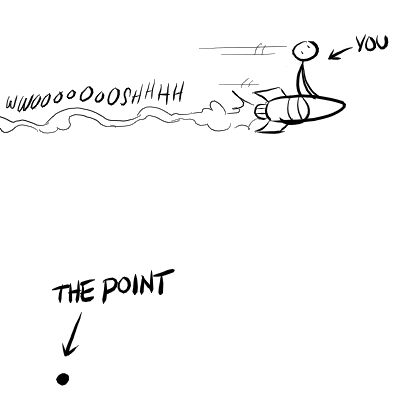
Perhaps I shouldn’t be so cynical, but I have no trouble believing any of his claims. Of course, that doesn’t mean I think he was right to do what he did. Looking forward to reading the book.
I’m going to make some art.
I’ve been wanting to learn the basics of photoshop-esque digital art for a while. I’m not a visual artist by any stretch of the imagination, but I’d like to be able to do more than just crop a photo or shift between color and greyscale, so I’m sitting in on a colleague’s Digital Art class. Two classes in and I’ve made a picture.
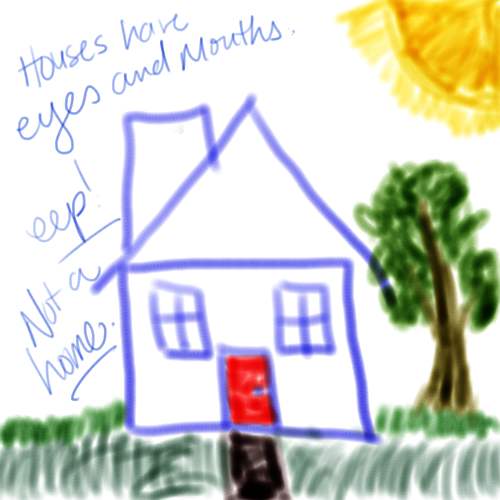 Clearly, I have a ways to go.
One of the projects for the class is a photo collection illustrating various color and visual principles, a project that gives me license to visit my craft room. I cannot begin to tell you how happy the thought of diving into the bins of yarn and fabric–not to mention the folders of paper and the buttons and…–makes me. Pretty.
So there will be posts here related to that class, which may lead to posts related to other things (like my writing class, where we’re focusing on the use of social media in elections. Team Romney, I’m not talking about you or linking to you or liking you because I like you. My interactions with your social media sphere are for science. So there. Nah nanny booboo).
It occurs to me that I should rename this blog. I’ve always meant to use this space to engage the topics that interest me, but I never write anything here because of my paralyzing fear of being–well, being anything.
That’s no way to live, is it, especially for someone who encourages students to write for self-discovery as much as anything. So I’m putting it out there right here, right now, for anyone who cares to know: I am a reluctant scholar.
I love teaching. I love to plan classes and assignments. I thrill at the possibilities of a pristine Moodle class. I can even admit to enjoying–truly enjoying–commenting on student writing (as long as I have space and time enough…).
I enjoy my service and administrative work; it gives me a chance to connect with colleagues and my institution in a variety of ways that are meaningful and potentially transformative. I like committee work. I enjoy contributing my knowledge and experience to help improve my school and community.
Bring up the word “scholarship,” though, and the color drains out of me. Reluctant may not be strong enough of a word, actually, to describe where I am with regard to scholarship. Don’t get me wrong: I have ideas. Loads of them. I read. I write. I talk and think and share in unmediated spaces with relative ease. I posit. I articulate. I ruminate. I just tend to do these things in ephemeral spaces.
I am reluctant to commit myself to memory.
Testing this out. Plus, I thought this was a cool vid.
It must be summer. I’m playing around with past and present web identities, trying to hit upon the perfect convergence of platforms to reach audiences I want to reach.
This post is meant to test out the new(ish?) WordPress–>Tumblr widget. I like tumblr, but it’s not great for conversation, not of the sort we expect of a blog. Not that I’ve every really thought of this blog as a space for conversation; I haven’t really ever seen open air blogs that way, preferring to conduct my “conversations” in the rapid stream of twitter or the selectively sequestered gardens of LiveJournal.
But it’s summer, and it’s the start of summer, so I’m going to try again. Let’s see how long I can go before updating this one…
I’m so jealous.
danah boyd wrote about something I’ve been meaning to write about for ages now. That can’t help but sound like so many sour grapes, but I can’t deny that I’ve scheduled a wee ass kicking for myself once I’ve finished making this post. Something about making hay and shining suns and such…
Anyway, in response to the exploding conversation about web -nymity (what kind of names are we going to allow? Real ones? Pseudo ones? Full frontal anon?), boyd writes many good things, including this bit of brilliance:
There is no universal context, no matter how many times geeks want to tell you that you can be one person to everyone at every point. But just because people are doing what it takes to be appropriate in different contexts, to protect their safety, and to make certain that they are not judged out of context, doesn’t mean that everyone is a huckster. Rather, people are responsibly and reasonably responding to the structural conditions of these new media. And there’s nothing acceptable about those who are most privileged and powerful telling those who aren’t that it’s OK for their safety to be undermined. And you don’t guarantee safety by stopping people from using pseudonyms, but you do undermine people’s safety by doing so.
“no universal context”, which is to say that when it comes to internet identity, context matters just as much as it does when we’re participating in any rhetorical activity. And just as a rhetor establishes and cultivates ethos by being sensitive to context, so must those shaping spaces where people gather be sensitive to the potentially explosive or destructive intersections of online and offline spaces.
I’ve spent the last year exploring this topic with my students, and the one thing that’s been clearest to them is that there’s a utility–and I’d claim it as social–to anonymity on the web. The “radical transparency” that sites like Facebook and Google Plus seek to establish shines too much light into the lives we’ve become comfortable living online; boyd points to the long-accepted–and perhaps even encouraged–tradition of pseudonymity and handles on the web. They don’t start there, though. There’s something seductive about the transparency argument; it’s just about keeping it real, simplifying things. It never occurs to them to consider the positive reasons why someone might want to be unknown–the desire for pseudo- or anonymity is always negatively construed at the start. Once we start looking around, though, and see the people we don’t usually see (the marginalized, as it were), real names start to look very dangerous, and the real conversation can begin.
So thanks to danah boyd for saying it and reminding me that I had something to say too.
 Anita DeRouen